
By Mukuma Musenga, CEO Kuala Tech
When *115# Becomes an Insurance Branch
How a USSD dial code became a live insurance distribution channel — and what it took to make it work.
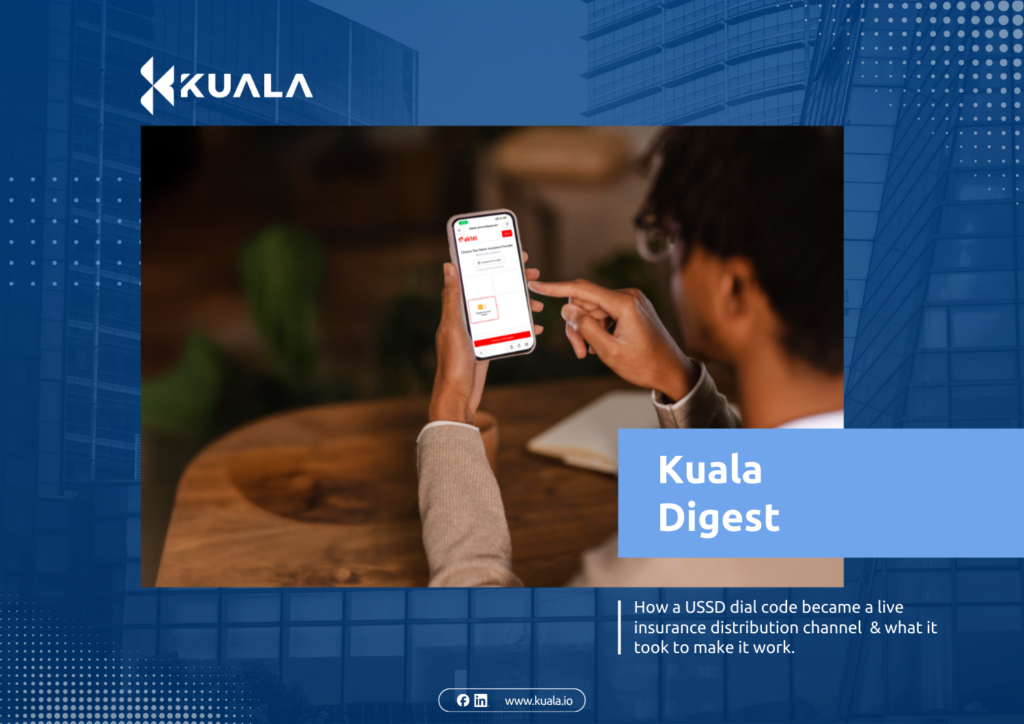
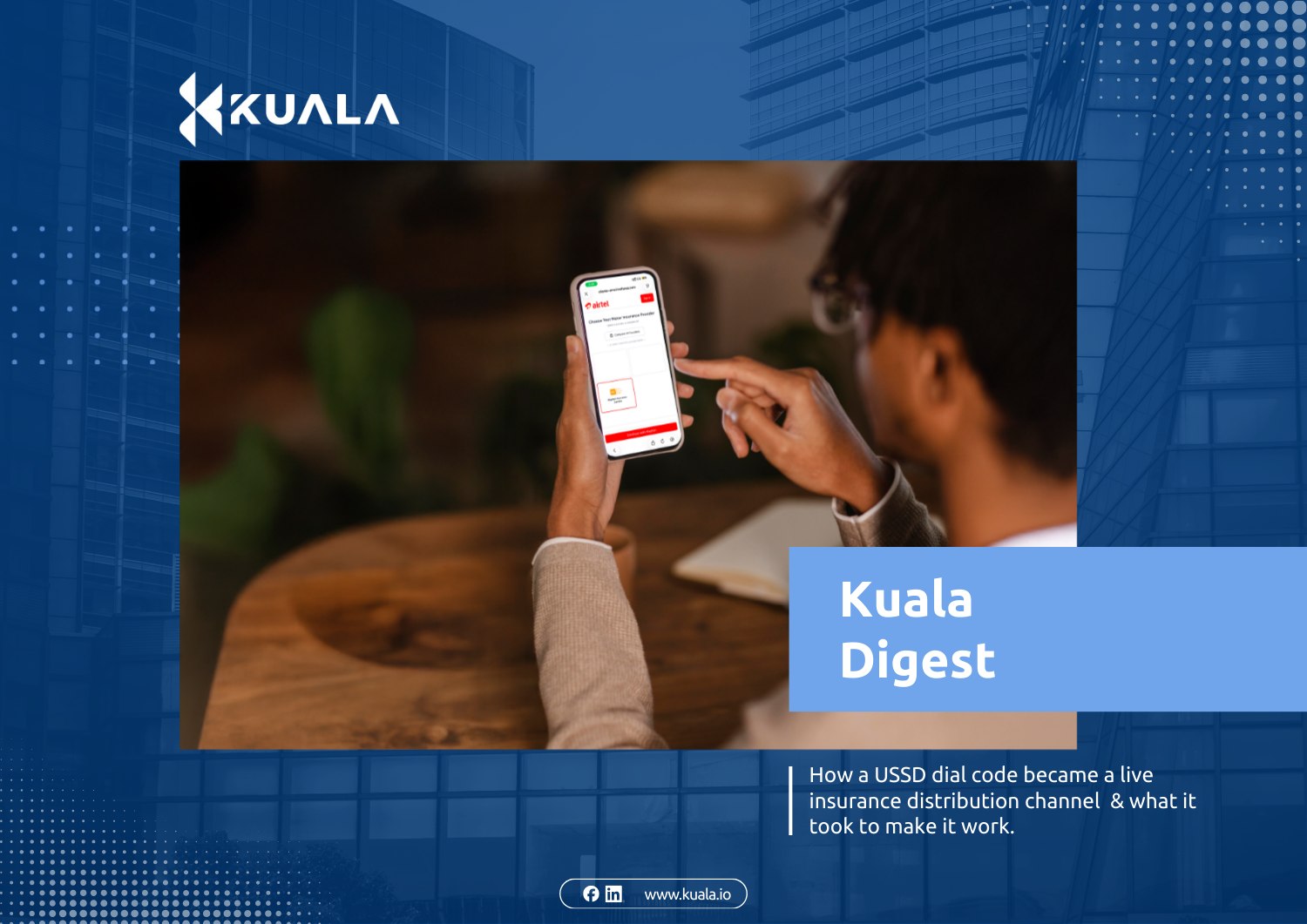
Airtel Money Zambia officially launched its Insurance Hub. Most people saw what they were meant to see: convenience.
Dial *115#. Select insurance. Receive a cover note.
Simple. But I always smile a little at moments like this — because I know exactly how much complexity is hiding behind that simplicity.
That space between the dial and the cover note? That is exactly where we operate.
The Day Insurance Moved into Your Pocket
As part of the new marketplace, Klapton Insurance Zambia rolled out Motor Third-Party and Personal Accident cover directly on USSD. Let me paint the picture.
There is someone sitting in Chawama. Or Chipata. Or Solwezi. They do not have data on their phone. They are not downloading apps. They do not have a broker’s number saved anywhere. They just need motor cover — today, before they drive.
They dial *115#.
Within minutes, they have valid insurance and a compliant cover note delivered digitally. No broker visit. No printer. No waiting room. No queue.
That experience feels light. Frictionless, even. But behind it is a fully configured core insurance system that we designed, built, and integrated — just to make that transaction possible in real time, every time, without fail.
If the customer never thinks about the technology behind it, we have done our job properly.
What Actually Happens in Those Few Seconds
This is the part that rarely gets told. When a customer selects that insurance option on their basic handset, a quiet cascade of events fires instantly inside the core platform:
- Product logic triggers the underwriting rules for that specific policy type
- Premium validation runs automatically against the product configuration
- Payment confirmation is received and reconciled in real time
- A policy record is created and stored inside the core system
- A compliant, regulator-ready motor cover note is generated
- The full transaction is logged for audit, reporting, and reconciliation
All of this has to work flawlessly. Not most of the time. Every single time. Because in insurance, “almost correct” is not a category. A policy is either valid or it is not.
That orchestration — from USSD input to compliant policy output — sits inside the core platform we developed and integrated for this rollout. It is not glamorous work. But it is the work that makes everything else possible.
Why USSD Still Wins — and Why That Matters
In boardrooms and conference panels, we love talking about apps, AI, embedded APIs, and seamless digital journeys. And we should. Those conversations are important.
But in Zambia — and across much of sub-Saharan Africa — USSD is still one of the most powerful tools for financial inclusion that exists. It works on any phone. It does not need data. It requires no download, no account setup, no smartphone. It is already familiar to millions of people who use mobile money every day.
Sometimes, innovation is not about inventing something entirely new. It is about using existing infrastructure more intelligently. More intentionally.
If we are serious about inclusion — not inclusion as a phrase in a strategy deck, but inclusion as a measurable outcome — we cannot design only for the top 10 percent of device users. We cannot build only for the connected, the urban, and the data-rich.
USSD forces discipline. It strips away everything that is not essential. It demands clarity of product design. It requires simplicity of user journey. In that sense, building well for USSD is a signal of good engineering, not a compromise of it.
Building for the basic phone is not a constraint. It is a test of how seriously you take inclusion.
This Was Not an Overnight Integration
Partnerships like this only work when insurers have genuinely done the foundational work. Not the announcement. The actual work. Digital distribution at scale — through mobile money, through USSD, through any channel — requires infrastructure that is ready before the conversation even starts.
That means:
- Products that are properly structured and configurable in a digital core — not PDFs, not spreadsheets
- API-ready architecture that external platforms can connect to without custom engineering every time
- Instant, compliant document generation that requires zero manual intervention
- Secure transaction logging that satisfies both operational and regulatory requirements
- Real-time reconciliation so that every payment and every policy can be accounted for, automatically
Without a modern core system in place, distribution conversations remain theoretical. Insurers can talk about digital channels all they want, but they cannot actually launch through them.
Our role at Kuala Tech Limited is to make those conversations executable. To close the gap between what an insurer wants to do and what they are actually able to do — technically, operationally, and at speed. Quietly, without fanfare, but with precision.
A Note on Our 2026 Direction
At the start of this year, we made a commitment — not internally, but publicly, in how we choose and execute our work. We said something straightforward:
We must build in ways that customers actually relate to. We must reach them as quickly as possible, through whatever channel is most accessible to them.
The Airtel Money Insurance Hub is one practical expression of that commitment. Not a slide. Not a strategic framework document. A live channel. A working integration. Real policies being issued, in real time, to real people who would otherwise have gone without.
That matters. And it is replicable.
Where This Is Going
USSD is one channel. It is an important one, but it is not the destination.
The bigger story here is infrastructure readiness — and what becomes possible when it exists. Once products are properly configured, integrations are stable, and processing is automated, the question of distribution becomes much simpler. Insurers who have done the foundational work can reach customers through:
- Mobile money platforms like Airtel Money, MTN, and Zamtel
- Aggregators and digital marketplaces
- Embedded insurance within lending, mobility, or retail platforms
- Agent networks equipped with digital tools
- Future channels we have not yet designed
The question stops being “Can we do this?” and starts being “How fast can we launch next?” That is the position we want every partner we work with to be in — ready to move, not still preparing.
Infrastructure readiness is not a one-time project. It is the foundation every future channel is built on.
Final Thought
True financial inclusion is not a marketing phrase. It is not a panel topic. It is a system that works on a basic phone in a township with no data connection. It is a policy issued in seconds. It is compliance handled automatically in the background, invisibly, correctly.
It is the person in Chipata who now valid motor cover has — not because the industry finally decided to care, but because someone built the infrastructure to make it possible.
We are building that infrastructure. And we are looking for insurers, platforms, and partners who are ready to use it.
If you are ready to move from strategy to live distribution — let’s talk.
Reach the Kuala Tech team at [email protected] — or reply directly to this digest.